Multi-tenant
One codebase serving every product on the platform
30+ live products, all inheriting the same tokens and components.
A multi-tenant, multi-themed design system built to serve financial institutions worldwide from one codebase — with a governance model designed to survive external team adoption at production scale.
A multi-tenant, multi-themed design system running the products used by financial institutions worldwide. Every deployment was a fully branded, client-specific experience — built on the same underlying tokens, components, and patterns.
The system had to hold up under three simultaneous pressures: multi-tenancy across live products, multi-theme rendering on the same components, and daily contribution from external teams building against it.
30+ live products, all inheriting the same tokens and components.
Four client brandings × Light and Dark modes — swap the tokens, never the components.
Building against the system, contributing back through governance, consuming continuously.
Technical architecture rarely determines whether a design system survives. Adoption does. External teams stopped reaching for the system when the overhead of finding the right component was higher than building their own.
Two failure modes surfaced repeatedly across the first years of production use. The governance model I built was a direct response to both.
Teams building outside the system
Local forks, silent divergence
When external teams needed a component that didn't exist yet, the fast path was to build it locally. Every local build was a fork — one more thing to reconcile later, one more inconsistency in production.
External teams waiting on a queue
Days of blocked work per request
Every request routed through the core team. Every proposal, every review, every publish. External teams shipped when we shipped — and we couldn't ship fast enough.
Governance had to solve for both — without slowing the core team, without opening the system to drift.
The core team needed full control over every variable. External teams needed speed — the ability to configure themes, layouts, and workflows without touching the underlying system. Branded client deployments needed a scoped layer where component-level overrides could live without leaking back into the shared system.
Forcing all three audiences through the same layer created the bottleneck. Three distinct layers — with different access rights, different levels of abstraction, and clear ownership boundaries — solved for adoption and integrity at the same time.
System anatomy · Five views of the same component
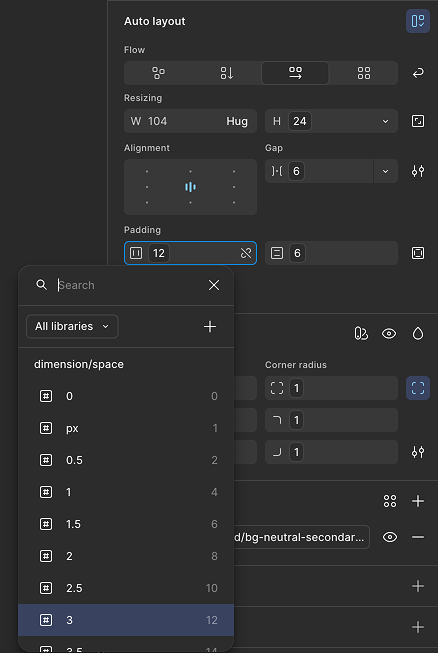

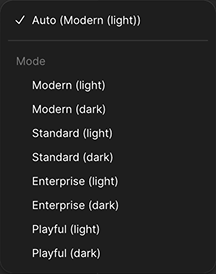
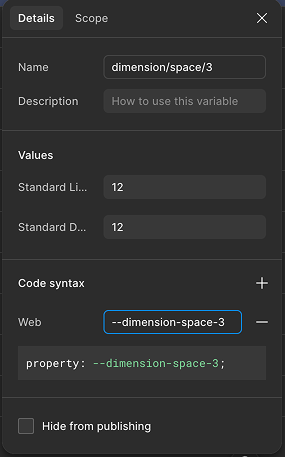

Following the dimension/space/3 token from variable definition, through auto-layout binding, through mode switching, to production CSS output.
External teams configure products · Core team governs the design system
The raw ingredients — colours, spacing, typography, radius. Owned by the core team. Every change here cascades through the whole system.
Primitives get a role in the system. Every component references semantic tokens, never primitives directly. Theme switching happens at this layer.
Reserved for cases where a client theme needed component-level overrides. Precise, scoped, used sparingly to keep the system maintainable.
Multi-theme evidence · 20+ tokens × 5 modes
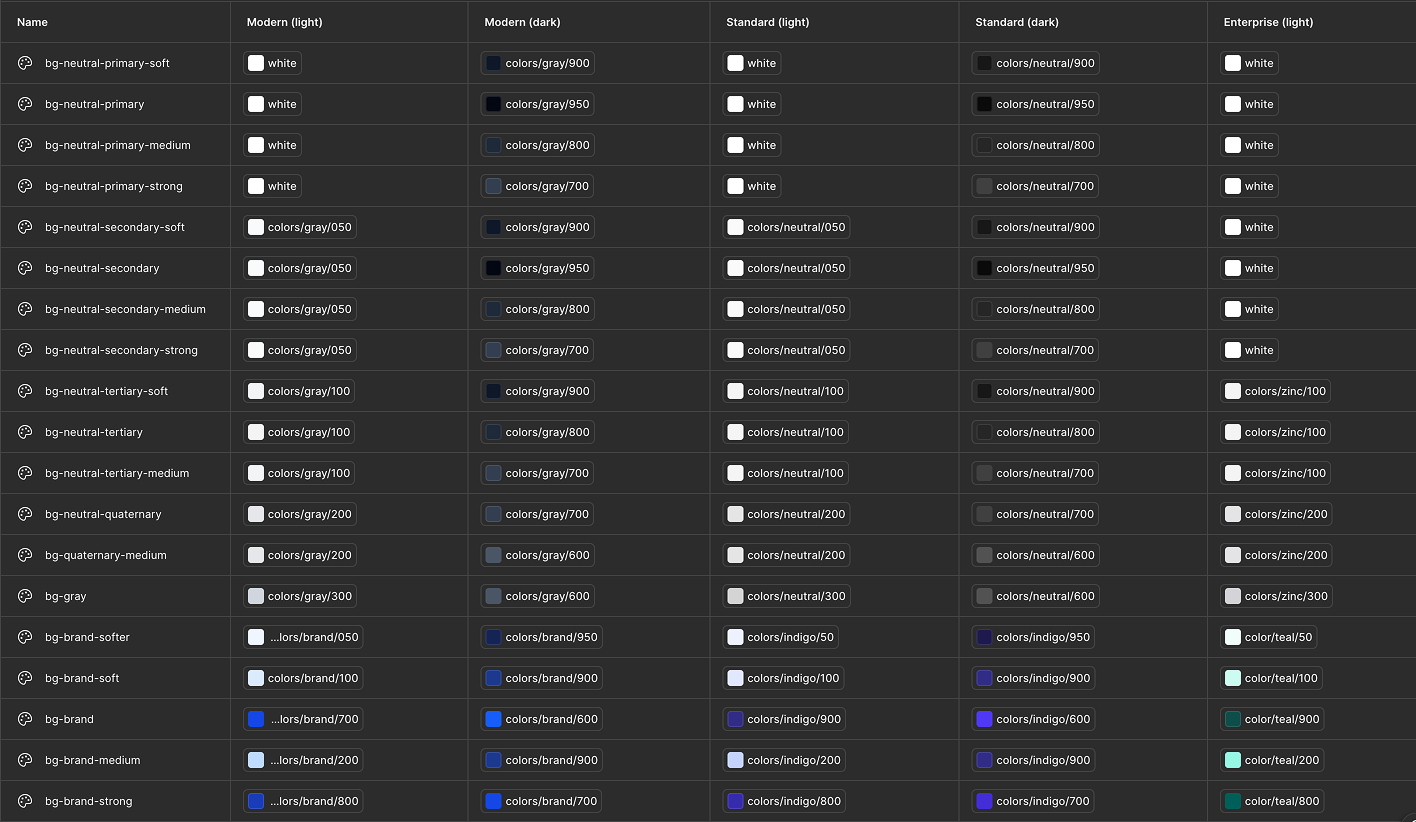
One semantic token — bg-neutral-primary-soft — resolving to different primitive values across every theme. Same components, entirely different visual identity.
Component tokens were the exception, not the default. Every proposed component token had to justify why a semantic token couldn't solve the problem. Roughly 15–20% of the total token count lived at this layer — enough to serve branded client requirements, contained enough to stay reviewable.
The same 379 components rendered across 8 themes — Light, Dark, plus specialised client branding. Every theme was a swap of semantic and component token values, not a rebuild of components. A new client brand added roughly a week of theme work.
Corporate security policies blocked standard cloud-to-cloud automation. The pipeline pulled tokens from Figma variables through the Figma API into a Local Pull CLI workflow — no cloud exposure, tokens propagated across all 900+ screens from a single update.
Local Pull CLI — no cloud exposure, tokens propagate across 900+ screens from one update
Governance in a design system is usually enforced by people — reviewers, gatekeepers, meetings. That model scales linearly with headcount, which is exactly what we couldn't afford.
The governance model I built shifted enforcement from people to process. Every contribution moved through the same track, every deprecation followed the same cycle, every version shipped with the same guarantees. External teams stopped waiting on approval; they followed the process.
Structured requests before code. Async review, no meetings required for most proposals.
Approved RFCs became pull requests. External teams graduated from consumers to contributors.
Automated warnings in Storybook and code, with a defined window before removal.
Every component with variants, states, and usage guidelines. Design and engineering docs unified.
Every release announced its impact. Teams knew exactly what changed before upgrading.
Governance stopped being a queue. It became a system that ran itself.
The measure of an enterprise design system isn't whether it launches. It's whether it survives the second year, the fifth external team, the twentieth deployment. Whether new products still reach for it, whether the core team can still ship at pace.
This design system did all of that. Below are the outcomes I can name with confidence.
8 themes · 1 line change · Modern · Enterprise · Standard · Playful
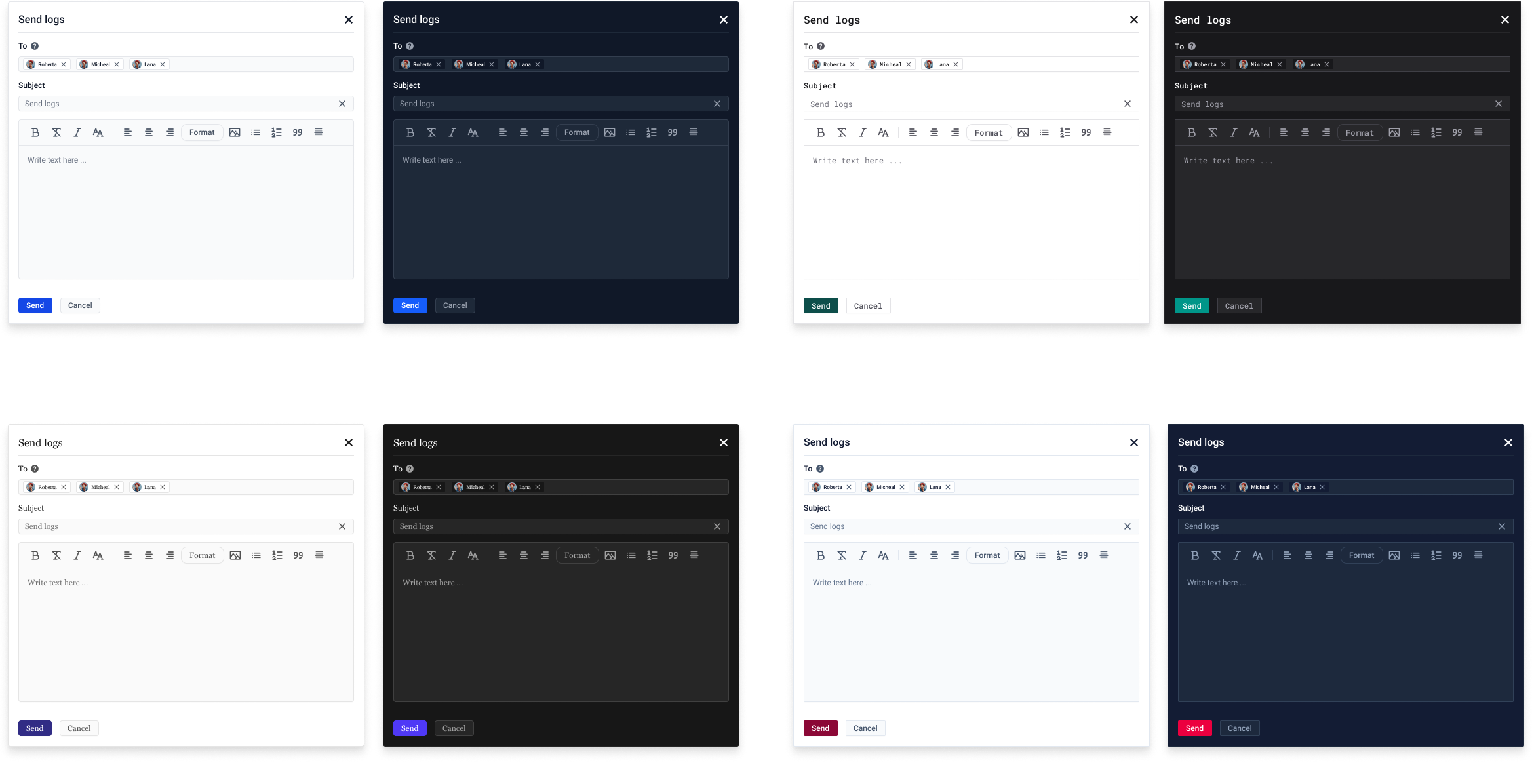
The Modal rendered across all four brand families in Light and Dark modes — same component, different tokens.
Colours, spacing, typography — owned by the core team as the single source of truth.
Every component aliased to semantic tokens by default, with scoped component tokens reserved for branded overrides.
Light, Dark, and specialised client branding — swap the tokens, keep the components.
Building against the system daily and contributing back through the RFC process.
Once the RFC and contribution model were in place, external teams stopped building around the system. Requests turned into pull requests. The core team reviewed instead of building from scratch.
Semantic versioning and deprecation cycles meant no downstream team was ever caught by surprise. No emergency migrations, no all-hands rewrites — updates shipped continuously, teams upgraded when they were ready.
The multi-theme architecture meant onboarding a new client brand was token work, never component work. A full themed deployment — 900+ screens, brand-perfect — turned around in a week of configuration.
The system was the reason the product portfolio held together. Every deployment shared the same interaction patterns, the same accessibility baseline, the same visual grammar — regardless of which team shipped it.


The most elegant token graph in the world doesn't matter if external teams don't reach for it. Every governance decision I made after year two was really an adoption decision — reduce friction, remove queues, give teams a clear path from problem to shipped solution.
Reviews, sign-offs, and gatekeeping don't scale linearly — they scale worse. Every ritual I built was designed to remove the core team from the critical path where possible. RFCs review async. Contributions merge on process, not opinion. Deprecations announce themselves.
Trying to serve every audience through one layer creates a system that's either too rigid for speed or too loose for consistency. Splitting into governed primitives, consumable semantics, and scoped component tokens let every audience work at the right level without stepping on each other.
The consumers of the system are the people writing code against it. Every decision — token naming, component API, documentation format, versioning cadence — is a product decision made for that audience. Design system leads who forget this ship documentation nobody reads.